


Hibernate skills appear inside Java back-end systems that store, retrieve, and update business data, not as a standalone front-end or database-administration specialty. By the end, you will be able to identify the Pune application sectors that use Hibernate, recognise the skills employers test, and judge whether a course prepares you for modern or legacy Java work.
Key takeaways
- Banking, insurance, hospital, and enterprise systems use Hibernate with relational databases.
- Master entity mapping, JPQL, transactions, lazy loading, and SQL debugging for Hibernate projects.
- Fix slow Hibernate queries by finding N+1 loads, checking indexes, and measuring generated SQL.
- Choose a course with Java, SQL, Spring, testing, and deployable Hibernate projects.
Which Pune Applications Use Hibernate in Their Back-End Systems?
Banking and fintech systems use Hibernate for accounts, payments, loans, and transaction histories. Insurance platforms map policies, claims, and premium records to relational database tables, while hospital management software handles patients, appointments, billing, and laboratory data.
| Application category | Typical records | Where Hibernate fits |
|---|---|---|
| Banking and fintech | Accounts, payments, loans, transactions | Persists financial records behind secure APIs and workflows |
| Insurance | Policies, claims, premiums | Connects policy and claim services to relational databases |
| Hospital management | Patients, appointments, billing, laboratory data | Supports clinical and administrative transactions |
| ERP | Inventory, purchasing, finance, human resources | Maps linked business modules and reporting data |
| E-commerce | Products, carts, orders, payments | Stores catalogue, checkout, and order lifecycles |
| CRM | Customers, leads, service cases | Links sales and support records |
| Payroll | Employees, attendance, salaries, tax records | Processes controlled payroll transactions |
| Logistics | Shipments, warehouses, routes, delivery status | Tracks movement across operational systems |
| Government services | Applications, documents, payments, citizen records | Supports portals and workflow updates |
Hibernate usually sits behind REST endpoints: a controller receives a request, a service applies business rules, and a repository or DAO uses JPA and Hibernate to read or save relational data. The same model transfers across service-company projects, product platforms, internal enterprise applications, and education software.
These hibernate framework applications in Pune create demand for hibernate developer skills within Java backend or full-stack roles, not usually isolated “Hibernate developer” jobs. Job descriptions more often combine Hibernate or JPA with Spring, REST, SQL, Git, testing, and build tools.
What Does Hibernate Look Like Inside a Java Application?
An HTTP request enters a controller, which validates input and calls a service. The service applies business rules, starts or joins a transaction, and asks a repository or DAO to load or save data. JPA and Hibernate perform that persistence work; Hibernate does not expose REST endpoints.
The repository uses an EntityManager or Hibernate Session inside a persistence context. Entity classes represent rows, identifiers map primary keys, and JPA annotations define columns and relationships: one-to-one, one-to-many, and many-to-many. JPQL, the Criteria API, and parameter binding create queries without concatenating unsafe values.
A relational schema still needs primary keys, foreign keys, constraints, and indexes. Hibernate generates SQL, but JDBC and SQL knowledge remains essential for joins, normalization, transaction failures, constraint violations, and database errors. JPA is the specification; Hibernate is a widely used implementation, so job descriptions that say Hibernate often expect JPA knowledge too.
| Application style | Working parts | What to recognise |
|---|---|---|
| Spring Boot REST API | Annotations, repositories, EntityManager, service transactions | Modern Java Hibernate training commonly uses this structure |
| Older Java EE application | XML mappings, hand-written DAO code, direct Session APIs | Longer-lived sessions and explicit persistence code require careful transaction handling |
| Hibernate developer skills in either style | Entities, JPQL or Criteria queries, SQL, JDBC, schema design | The framework changes; core database reasoning does not |
A persistence context tracks managed entities and detects changes at commit. A course should show both the convenient annotations used in new applications and the older APIs still found in maintenance work.
Which Hibernate Developer Skills Matter in Pune Job Projects?
Pune employers assess Hibernate as part of a Java backend skill set, not as annotation memorisation. Strong java hibernate training should build competence in:
- Core Java collections, object-oriented design, exception handling, and JDBC basics
- SQL joins, normalization, indexes, constraints, and transaction boundaries
- JPA annotations, entity relationships, JPQL, Criteria queries, pagination, and REST APIs
- Git, Maven or Gradle, validation, unit tests, integration tests, and debugging
Practical mapping exposes mistakes that a CRUD demo hides. Choose the owning side of a bidirectional relationship deliberately, prevent recursive JSON with DTOs or controlled serialization, and use cascade operations only for operations the parent truly controls. Set orphanRemoval to true only when the child cannot exist independently.
Map composite keys with EmbeddedId or IdClass, then select inheritance strategies based on the schema and query patterns.
| Pune project context | Skill applied | Failure support may involve |
|---|---|---|
| Service-company client work | REST, mappings, SQL, Git | Tracing a failed transaction |
| Product or fintech teams | Pagination, validation, integration tests | Correcting a legacy mapping |
| Enterprise, maintenance, or support roles | JDBC, JPQL, debugging | Explaining constraint violations |
New development also requires API design and controlled database changes through Flyway or Liquibase. Hibernate skills matter differently across these roles, but every team needs developers who can connect Java objects to reliable relational data rather than merely reproduce annotations.
How Do You Find and Fix Hibernate Performance Problems?
A Hibernate application can return correct results and still overload the database. The classic N+1 pattern runs one query for parent rows, then one child-collection query for every parent.
| Problem | What to inspect | Practical remedy |
|---|---|---|
| N+1 queries | SQL count and repeated child selects | JPQL join fetch, EntityGraph, or batch fetching |
| Excessive data | Row count and selected columns | Keep relationships lazy and fetch only the required graph |
| Slow pages | Offset, joins, and execution plan | Use bounded pages, indexed ordering, or keyset pagination |
| Memory pressure | Session duration and loaded entities | Short transactions and bulk JPQL or JDBC updates |
Do not make every relationship eager: oversized fetches create duplicate rows, unbounded collections consume memory, and long sessions retain entities. Add indexes to foreign-key columns used in joins.
Before changing mappings, measure row counts and response time, enable SQL and bind-parameter logging in a local project, compare generated SQL with the intended query, and inspect its execution plan in the project database.
The persistence context is Hibernate’s first-level cache. Second-level and query caches need deliberate configuration, invalidation rules, and memory limits; they cannot repair poor SQL and can return stale data.
These checks are core Hibernate developer skills in Hibernate framework applications in Pune. Choose JDBC, native SQL, jOOQ, stored procedures, or a separate analytics pipeline when you need hand-written control, database-specific operations, or large analytical and bulk workloads.
How Should You Evaluate a Hibernate Framework Course in Pune?
A hibernate framework course in Pune is worth comparing by its project evidence, not by the number of annotations in its syllabus. The project should build a Java CRUD application with PostgreSQL or MySQL, expose REST endpoints, map one-to-many and many-to-many relationships, and use JPA concepts alongside Hibernate-specific APIs.
| Evidence to check | What the project should show | Why it matters |
|---|---|---|
| Data and queries | JPQL, parameter binding, pagination, SQL logging, and N+1 diagnosis | You can connect generated SQL to slow or incorrect results |
| Application behaviour | Service-layer transactions, validation, exception handling, rollback, and a deliberate LazyInitializationException demonstration | You learn where production failures occur |
| Delivery and testing | Flyway or Liquibase migrations, Git, unit tests, and integration tests with PostgreSQL, MySQL, or a containerized database | You test mappings, constraints, transactions, and schema changes against a real engine |
Ask the provider to show the repository, test reports, migration files, and generated SQL. National Computer, Typing, Beauty & Fashion Design should be compared with other providers using those artefacts, not a course title alone.
Reject a syllabus limited to annotations, automatic schema creation, and basic CRUD. Those exercises hide constraint violations, generated-SQL errors, transaction boundaries, and real mapping problems.
Java Hibernate training is stronger when its final project also demonstrates Spring or Spring Boot integration, REST, SQL debugging, Git, and testing—the combination Pune employers seek in Java backend and full-stack roles.
Related products
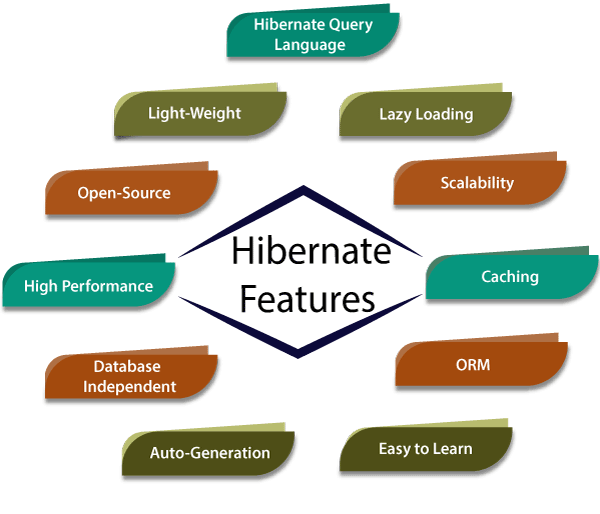 | Software and Programming courses Simplified Data Access. ... Object-Relational Mapping (ORM) Capabilities. ... Database Independence. ... Automatic SQL Generation. ... View product → |
 | Software and Programming courses Spring is a lightweight framework. It provides the best mechanisms for different frameworks, such as Struts, Hibernate, EJB, JSF, and Tapestry. View product → |
Frequently asked questions
Which applications use Hibernate in Pune?
Pune back-end teams use Hibernate in banking and fintech systems, insurance platforms, hospital management software, and enterprise applications that store relational data.
What does Hibernate do inside a Java application?
Hibernate maps Java entities to relational database tables, generates SQL for queries and updates, manages object relationships, and supports transactions through the persistence layer.
Which Hibernate developer skills matter in Pune projects?
Employers value entity and relationship mapping, JPQL, native SQL, transaction handling, lazy and eager fetching, pagination, validation, testing, Spring integration, and SQL troubleshooting.
How do you fix Hibernate performance problems?
Inspect generated SQL, identify N+1 queries, add suitable database indexes, use fetch joins or batch fetching carefully, limit selected columns, paginate large results, and measure changes with logs or profiling.
How should you evaluate a Hibernate framework course in Pune?
Check whether the course includes Core Java, SQL, JDBC, JPA, Hibernate mappings, Spring integration, transactions, testing, debugging, performance tuning, and a project that uses a real relational database.
Related products
 | Software and Programming courses MVC support. ... Code reuse. ... Plug-and-play feature. ... Data binding feature. ... Large community support. ... View product → |
 | Software and Programming courses ADVANCED JAVA PROGRAMMING(JEE) Advanced Java is a popular choice for web applications, as it's easy to use and has a high level of security. View product → |