


Choosing Django training requires more than finding a class that teaches Python syntax or basic web pages. By the end, you should know what Django is suited to build, which skills and projects a serious course must include, and how to compare local training options with your career goal.
Key takeaways
- Learn Python basics, HTTP, HTML, CSS, SQL, and Git before Django.
- Choose Django for structured applications with authentication, forms, admin, and database tools.
- Build projects that include testing, security controls, deployment, and maintenance.
- Compare course projects, code reviews, deployment practice, and trainer support before enrolling.
What Django Builds and How It Uses Python
Django is a Python web framework for building complete web applications without assembling every basic feature yourself. URL patterns send requests to view functions or class-based views; views use models and the Django ORM to read or change database records, process forms, apply authentication rules, and return a response.
Django also provides an automatically generated admin interface for managing model data.
A typical request flows through these parts: a URL matches a view, the view runs Python application logic, the ORM queries the database, and a template presents the result as HTML. Templates handle presentation; Python handles decisions, calculations, permissions, and business rules. Django can also return JSON with tools such as JsonResponse.
- Blogs with posts, comments, authors, and login
- Inventory systems with products, stock levels, and supplier records
- Booking platforms with availability and reservations
- Dashboards, marketplaces, and internal business tools
A django course in Pune should distinguish Django’s built-in web features from an additional API tool.
| Capability | Django itself | Django REST framework |
|---|---|---|
| Response and presentation | HTML templates or JsonResponse | Structured API responses |
| API structure | Basic JSON endpoints | Serializers for transforming and validating data |
| API access control | Django authentication and permissions | API authentication and permission classes |
| Testing | Django test client and database tests | API-focused request and response testing |
Django is useful because these integrated parts give a project consistent structure, while still allowing ordinary Python code wherever application logic requires it.
What You Should Know Before Starting a Django Course
You are ready for Django when you can follow Python code, work with basic web pages and databases, and use Git without copying every command blindly. A python django course in pune should test these abilities before moving into framework features.
1. Check your prerequisites: Python variables, functions, classes, exceptions, modules, virtual environments, and package installation; HTML and CSS basics; SQL tables, primary keys, joins, and filtering; and Git commands for commits, branches, and remote repositories. Advanced mathematics is not required for ordinary Django development. Logical thinking and problem-solving are essential.
2. Expect the syllabus to cover project and app structure, URL patterns, views, templates, template inheritance, forms and validation, models and relationships, querysets, filtering and aggregation, migrations, database configuration, and the admin site. It should also include authentication, sessions, groups and permissions, static files, media uploads, REST APIs, automated testing, Git, deployment, and documentation.
3. Judge practical depth by the exercises. You should build an application, configure its database, create migrations, test database-backed behaviour, and deploy it using environment settings rather than relying on runserver. The course should explain WSGI or ASGI and a production web server.
Do not merely memorise model syntax. Understand when a queryset triggers database access, how filtering and aggregation affect the query, and how relationships shape the result. A course that skips this reasoning prepares you to copy examples, not maintain Django software.
Django Compared With Flask, FastAPI, Laravel and Frontend Frameworks
Choose Django when you want a structured Python application with database-backed features ready to connect. Its ORM models data, authentication manages users and permissions, forms handle input, and the admin panel provides internal management screens without assembling each component yourself.
| Framework | Strength | Best fit |
|---|---|---|
| Django | Batteries-included Python framework with ORM, authentication, forms, templates, and admin | Portals, marketplaces, dashboards, booking systems, and business tools |
| Flask | Small core that relies on extensions | A focused service where you want to choose each component |
| FastAPI | Python API framework with type-hint support and automatic API documentation | API-first systems and lightweight services |
| Laravel | Full-featured PHP framework with a large PHP ecosystem | Teams already building and hiring in PHP |
| Spring Boot | Java framework for enterprise applications and existing Java infrastructure | Large systems, corporate teams, and Java-based career paths |
Flask suits a smaller service when Django’s conventions feel excessive. FastAPI fits an API-first project, especially when typed request and response schemas matter. Laravel or Spring Boot makes more sense when your team, codebase, or target jobs already use PHP or Java.
Do not confuse Django templates with React or Angular. Django templates render HTML on the server; React and Angular are JavaScript frontend frameworks that communicate with a backend through pages or APIs. Choose according to project requirements, your language skills, local job listings, and your willingness to learn frontend JavaScript—not popularity alone.
Searches for django classes wagholi should lead you to compare this career direction with the actual projects taught.
The Project Workflow, Security and Deployment Skills Employers Expect
Start with written requirements, user roles, acceptance criteria and a Git repository, then create a virtual environment and separate development, testing and production settings. Define related models, create and apply migration files, and build more than a CRUD screen: add a blog, inventory, booking or user-account workflow.
A useful project must prove that you can:
- Validate forms and model data, enforce permissions, handle 404 and database errors, and protect authenticated actions.
- Test models, URL patterns, views, authentication and database-backed behaviour with automated tests.
- Keep business logic in Python rather than templates, which should present escaped context data. Skipping migrations, exposing SECRET_KEY, leaving DEBUG=True, trusting unsanitised input, storing plain-text passwords, or misconfiguring CSRF protection reveals weak training.
Django supplies CSRF tokens, parameterised ORM queries that reduce SQL-injection risk, clickjacking protection and salted password hashing. Configuration still matters: permissions, secure cookies, allowed hosts and input validation remain your responsibility.
Static files such as CSS and JavaScript are separate from user-uploaded media; learn collection, storage, serving and access controls for both. Store SECRET_KEY and database credentials in environment variables, configure the database explicitly, and deploy through WSGI or ASGI behind a production web server. runserver is for development, not production.
Synchronous code handles work in sequence; asynchronous code helps with concurrent I/O when the stack supports it. Async is not an automatic speed guarantee.
| Approach | Best fit | Risk to test |
|---|---|---|
| Synchronous | Standard Django views and ORM work | Blocking slow I/O |
| Asynchronous | Concurrent network-bound tasks | Unsupported blocking code |
| Mixed | Async endpoints with careful boundaries | Complex debugging and transactions |
A django training near Wagholi is worth considering only if its final project documents this workflow and deploys it.
How to Evaluate Django Training in Pune or Wagholi
Judge a local course by the work you can inspect and explain, not by its title or brochure length. Before enrolling in a Django course in Pune, request these specific proofs:
1. Ask for the written syllabus, instructor-led project plan, assessment method, Git workflow, test examples, deployment exercise, and final documentation. A project plan should show requirements, virtual-environment setup, commits, reviews, testing, deployment, and handover notes.
2. Check that learners build a complete application rather than copy a CRUD screen. The project should include validation, user permissions, related models, error handling, automated tests, and a production-ready configuration. Ask learners to explain why each part exists.
3. Confirm what “REST API” means in the syllabus. Does the work use Django views that return JSON, or Django REST framework with serializers, authentication, permissions, validation, and API tests?
4. Ask to inspect a sample project tree containing settings, URLs, apps, migrations, templates, static files, media handling, tests, and environment configuration. Check that static assets are separated from user uploads and that runserver is not presented as the production server.
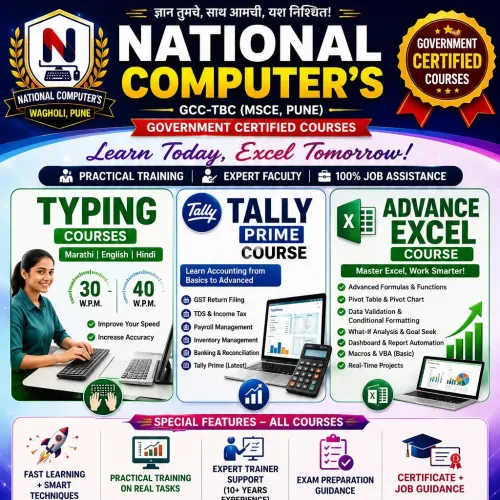
5. Compare Django classes Wagholi and Django training near Wagholi by instructor feedback, lab access, project review, and evidence of deployment and testing. National Computer, Typing, Beauty & Fashion Design belongs in that comparison only when it can show the same practical evidence.
A promised certificate or unverified placement claim cannot prove usable skill. A strong course leaves you with a tested, documented application you can deploy and discuss in an interview.
Related product
 | Software and Programming courses Django Python Web Development |
Frequently asked questions
What does Django build, and how does it use Python?
Django builds complete web applications using Python views, URL patterns, models, the Django ORM, forms, authentication, and templates.
What should you know before starting a Django course?
Study Python fundamentals, object-oriented programming, HTTP, HTML, CSS, SQL, relational databases, Git, and basic command-line use.
How does Django compare with Flask, FastAPI, Laravel, and frontend frameworks?
Django provides more built-in application features than Flask and FastAPI, uses Python unlike Laravel, and handles backend work rather than replacing frontend frameworks.
Which project, security, and deployment skills do employers expect?
Practise requirements analysis, database design, testing, authentication, CSRF protection, input validation, secure settings, Git workflows, deployment, logging, and maintenance.
How should you evaluate Django training in Pune or Wagholi?
Compare syllabus depth, instructor feedback, live project work, code reviews, deployment practice, class timing, batch size, and support after lessons.