


Choosing between 30 WPM and 40 WPM depends on the examination, job requirement, and your present accuracy—not on which number sounds better. You will be able to compare the targets, interpret typing-test scores, verify GCC-TBC rules, and choose a practical Pune training plan without confusing a private course certificate with an official examination certificate.
Key takeaways
- Choose 30 WPM for beginners without a reliable typing baseline.
- Choose 40 WPM when a recruitment test demands it.
- Verify the GCC-TBC syllabus, exam format, and certificate details before enrolling.
- Track timed tests, errors, and net speed each week.
30 WPM or 40 WPM: Which Target Fits Your Goal?
Choose 30 WPM if you are a beginner, type slowly, or have no reliable baseline. Choose 40 WPM if a clerical or government recruitment test requires it, or you already touch-type with consistent accuracy.
One typing word conventionally equals five keystrokes, including spaces: 30 WPM is about 150 keystrokes per minute, while 40 WPM is about 200.
| Target | Best fit | What to prove |
|---|---|---|
| 30 WPM | Beginners and slow typists | Controlled rhythm with accurate letters, spaces, capitals, punctuation, and corrections |
| 40 WPM | Recruitment applicants and reliable touch typists | Stable accuracy through longer passages, not just a short burst |
| 30 then 40 | Learners without a baseline | Repeat 30 WPM accurately before increasing speed |
Gross WPM counts everything typed. Net WPM deducts errors, so typing 40 gross WPM with frequent mistakes can leave you below a 30 WPM accuracy-adjusted requirement. A five-minute online score does not equal a formal result unless the language, keyboard layout, passage difficulty, duration, and scoring rule match.
For computer English typing 30 or 40 WPM in Pune, an English typing 30 WPM course in Pune suits a controlled first milestone. Progress to an English typing 40 WPM course in Pune after your accuracy remains stable on longer passages and while handling punctuation, capital letters, spaces, and backspacing.
A single best score proves little; record gross WPM, net WPM, accuracy, errors, duration, and the text used.
What to Verify Before Preparing for GCC-TBC English Typing
Verify the current MSCE examination notice before paying for GCC TBC English typing in Pune. An advertised class is not automatically an authorised examination centre, and 30 WPM and 40 WPM are separate English typing levels, not one combined qualification.
| Level | Meaning | What to confirm |
|---|---|---|
| 30 WPM | About 150 keystrokes per minute | Whether the official test records gross or net speed |
| 40 WPM | About 200 keystrokes per minute | Whether errors reduce the reported speed or cause failure |
A private institute’s completion certificate is not automatically a GCC-TBC certificate. Confirm who conducts the examination, who issues the certificate, and whether the centre handles registration or only provides training.
Before enrolling, check these points against the latest official notice:
- Test duration, passage length, text format, and permitted mistakes
- Accuracy percentage, error-deduction rule, or defined speed-after-deduction formula
- Keyboard layout, including QWERTY or another input setting
- Treatment of capital letters, punctuation, spaces, Backspace, and corrections
- Examination software and whether practice uses the same or comparable system
- Current authorised-centre list, examination schedule, syllabus, and examination fees
- Registration deadline, documents required, and the party responsible for submission
- Certificate-issuing authority and the name printed on the certificate
Do not accept a five-minute online typing score as proof of GCC-TBC readiness unless its language, keyboard, passage difficulty, duration, and scoring rule match the official test. Compare every claim with the current MSCE notice, not an old pamphlet or an unverified web page.
How Training Moves You from Looking at Keys to Reliable Speed
Begin with a timed baseline test before changing your technique. Record gross WPM, net WPM, accuracy percentage, error count, passage length, and test duration. This shows whether speed or accuracy is the immediate problem.
Use this checklist as your progression:
- Place the left hand on A, S, D, F and the right hand on J, K, L, and the semicolon key; keep both thumbs available for the spacebar. Practise returning to the home row after every reach.
- Drill individual letters, short words, and controlled finger movements without looking down. Looking at the keys can produce a quick score increase while weakening touch-typing habits.
- Add difficult combinations such as th, ing, tion, and qu, then practise consecutive words requiring the same finger.
- Include numbers, punctuation, Shift, Backspace, Enter, and repeated spacebar use. Alphabet-only drills do not prepare you for office entry.
- Finish with timed passages that include capitals, punctuation, spaces, and corrections. Classify every error as a wrong letter, missed space, extra space, capitalisation error, punctuation error, or correction delay.
Chasing 40 WPM before your fingers are accurate reinforces incorrect fingering and creates unstable speed. Touch typing is more dependable than hunt-and-peck typing for transcription and office entry because you keep your eyes on the source text and recover from errors faster.
Typing-focused training does not automatically include Word, spreadsheets, file management, email, or printing. Confirm that those modules appear separately in the course outline.
A Practice Schedule That Measures Real Progress
Use three to five keyboard sessions each week, but treat the schedule as a repeatable routine rather than a promise of reaching 30 or 40 WPM by a fixed date. Practise at home on a physical computer keyboard; a phone develops different movements and does not replace keyboard time.
A 30- to 45-minute session can follow this order:
- Warm up for five minutes with easy words and home-row movements.
- Drill accuracy for 10 to 15 minutes using short passages at a comfortable pace.
- Rest briefly before your timed work.
- Type two or three timed passages, then review every error.
Begin with accuracy-focused passages. Raise speed only after you can repeat the target with a low, stable error rate; otherwise, faster practice teaches you to repeat the same mistakes. Add longer passages as your control improves, because fatigue exposes missed capitals, extra spaces and repeated backspacing.
Compare results only under matching conditions: the same keyboard type, passage length, English language, keyboard layout and scoring rule. Keep practice scores separate from mock-test scores, and record the date, duration, gross WPM, net WPM, accuracy percentage and error categories, such as wrong letters, missed spaces, capitals or punctuation.
A five-minute online score is not proof of GCC-TBC readiness unless its duration, text, layout and error deductions match the official examination. Rest intervals protect accuracy as much as speed.
How to Compare Pune Typing Classes Before You Enrol
Compare the training method, not the advertised speed. An English typing 30 WPM course in Pune suits a learner building technique or setting a measurable first target; an English typing 40 WPM course in Pune suits a job or examination that demands 40 WPM after you can sustain accurate 30 WPM.
| Option | Best fit | Evidence to demand |
|---|---|---|
| 30 WPM class | Beginner or slow typist correcting fingering | Baseline test, accuracy record, technique correction, timed passages |
| 40 WPM class | Learner with stable 30 WPM accuracy | Longer mocks covering punctuation, capitals, spaces and corrections |
| Self-study | Disciplined learner with keyboard access | Comparable test records, error review and independent assessment |
Before enrolling in any computer typing classes near me, ask the provider:
- How many total guided practice hours are included, and how many learners share a batch?
- Can you practise on a full-size physical keyboard outside demonstrations? Phone practice does not replace computer-keyboard practice.
- Is the layout QWERTY, and which practice software and test duration do you use?
- Do you record gross WPM, net WPM, accuracy percentage, error count, passage and duration in the baseline test?
- Who corrects finger technique, and what errors count under the error policy?
- How many timed mock tests and what final assessment are included?
- Does the fee separately include examination registration, and who issues the certificate?
- Does the course prepare you for a named official test or teach general typing only?
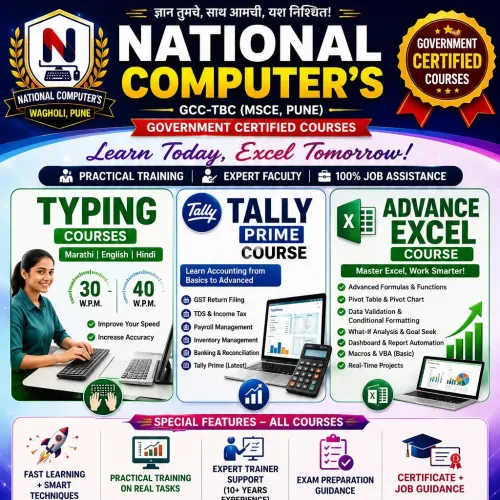
National Computer, Typing, Beauty & Fashion Design is worth comparing with other Pune providers only if its answers match your baseline and show keyboard access and assessment evidence. Choose proof over a short duration or the word “computer” in a course name.
Frequently asked questions
Should you choose 30 WPM or 40 WPM English typing?
Choose 30 WPM if you are a beginner or lack a reliable baseline. Choose 40 WPM if a clerical or government recruitment test requires it, or you already type accurately without looking at the keys.
What should you verify before preparing for GCC-TBC English typing?
Ask the class about the current GCC-TBC syllabus, required typing speed, test format, practice material, examination process, and certificate details before enrolling.
How can typing practice improve speed reliably?
Build touch-typing habits first, then increase speed while protecting accuracy. Use timed tests and record gross speed, errors, and net speed to measure progress.
How do you compare computer typing classes near you in Pune?
Compare supervised practice time, keyboard access, instructor feedback, timed-test tracking, batch size, course schedule, and preparation for your specific 30 or 40 WPM goal.